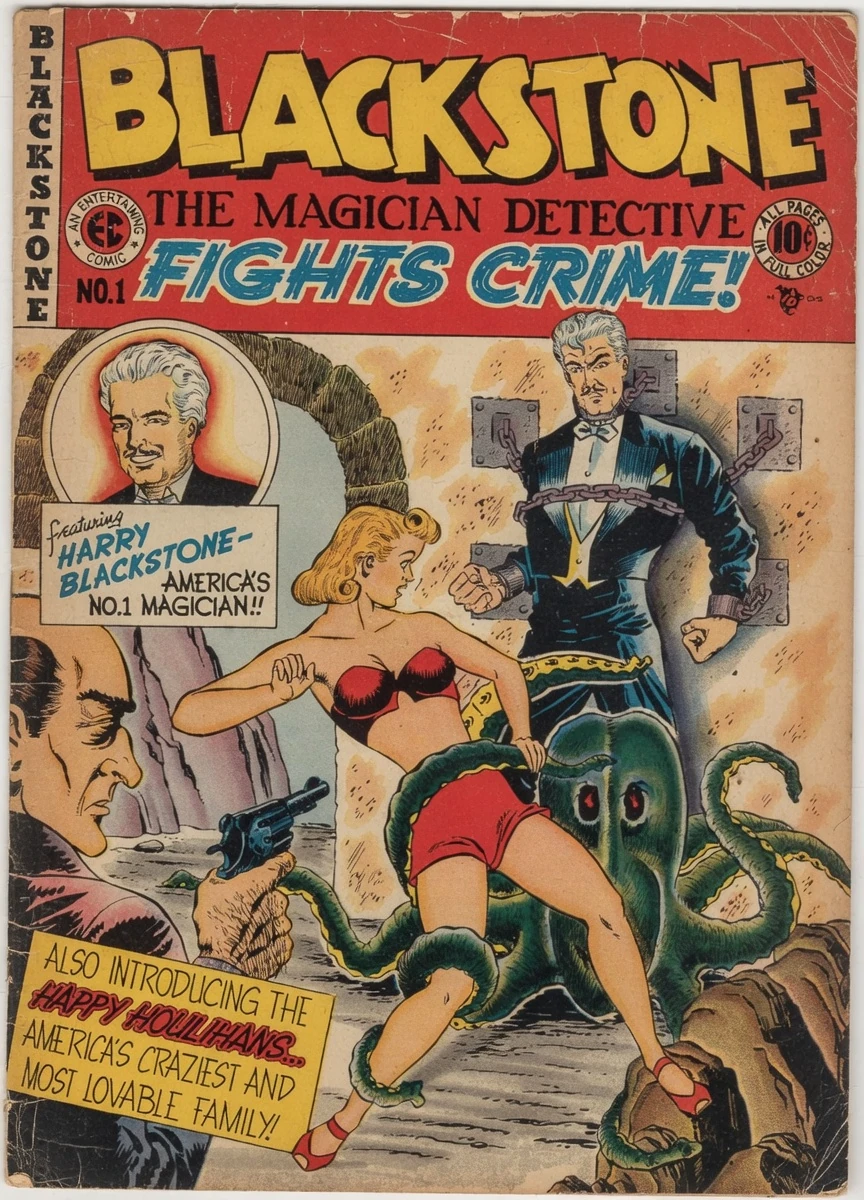
Blackstone, The Magic Detective
A Magician Steps Into the Radio Studio
The hook for Blackstone, The Magic Detective was simple and genuinely clever: take one of the most famous stage magicians alive, build a radio adventure series around a fictionalized version of him, and close every episode with an actual magic trick kids could go try on their friends. The show debuted on WOR-Mutual on October 3, 1948, running Sundays at 2:45 in fifteen-minute installments, and continued on the Mutual Broadcasting System through at least March 26, 1950. It aired in transcribed syndication, meaning episodes were recorded and distributed rather than broadcast live.
Ed Jerome played the title role, with his character described each week as "the world's greatest living magician." Ted Osborne played Blackstone's friend John, whose function in each episode was frankly mechanical — he existed to express doubt and fright at the right moments. Fran Carlon played Rhoda Brent, the third member of Blackstone's circle; she had gotten her start in radio doing commercial spots on Amos 'n' Andy. Don Hancock announced for the first stretch, from October 1948 through June 1949, and Alan Kent took over from July 1949 through the final broadcast. Unusually, both announcers appeared as characters within the episodes themselves, stepping into storylines rather than remaining offstage voices. Bill Meeder provided the organ music.
How Each Episode Worked
The show had a set structure that it stuck to throughout its run. An episode would open in Blackstone's magic studio, where John or one of the announcers would discover some unusual object — a chainsaw, a talking skull, a fishbowl — and that discovery would prompt Blackstone to start telling the story of a mystery case connected to it. The case then played out in flashback as a dramatized adventure, and every one of those adventures reached a resolution that involved some feat of magic. The audience was challenged, during a commercial pause, to figure out the magical solution before Blackstone explained it. That interactive wrinkle gave the show a game-show quality inside its adventure format.
After the explanation came a short segment where Blackstone described a practical magic trick — a balancing egg, a walking hatpin, a disappearing coin — designed for kids to perform at home. The explicit goal was letting young listeners mystify their friends. For a fifteen-minute program, that's a lot of ground covered: frame story, flashback adventure, puzzle challenge, solution reveal, and a tutorial segment.
The People Behind the Character
The real Harry Blackstone Sr. — born Henry Boughton in Chicago on September 27, 1885 — was a genuine figure in American stage magic. Billed as "The Great Blackstone," he was considered one of the last practitioners of the courtly, full-illusion style associated with Howard Thurston and Harry Kellar. His signature effects included the Floating Light Bulb, the Vanishing Birdcage, and the Dancing Handkerchief, with the Floating Light Bulb becoming his best-known piece. During World War II, he toured a full illusion show to 165 military bases under USO auspices, supplying his own lights, ladders, and curtains. In 1942, at a theater in Decatur, Illinois, he quietly evacuated an entire audience by announcing that his next trick required everyone to step outside — then told them the building was on fire, an act widely credited with saving lives. He died on November 16, 1965, in Hollywood, at age 80.
The scripts were written primarily by Walter B. Gibson and Nancy Webb. Gibson's connection to Blackstone Sr. ran deep: he had ghostwritten books on magic for Blackstone Sr. as well as for Harry Houdini, Howard Thurston, and Joseph Dunninger. Gibson is better known as the creator and primary author of The Shadow pulp fiction series, written under the house name Maxwell Grant — he authored at least 283 of the 336 Shadow novels. He also wrote the Blackstone comic books that preceded the radio series. According to Thomas J. Shimeld's biography Walter B. Gibson and The Shadow (McFarland & Company, 2005), Gibson helped develop 147 radio scripts and covered Blackstone's adventures across 394 comic books and newspaper strips over his career. Webb had previously worked with Gibson on Chick Carter, Boy Detective.
The comic book series that directly inspired the show was created by Elmer Cecil Stoner, an African American comics artist and commercial illustrator. Stoner's Blackstone, Master Magician launched in 1946 through Vital Publications as a three-issue run, then was revived by EC Comics and later by Marvel Comics. Stoner had contributed pencil art to the first issue of Detective Comics and worked for Timely, Street & Smith, Fawcett, and Dell — and he is credited, with some dispute, as the artist who added the top hat, monocle, and cane to the winning entry from the 1916 Planters logo contest, creating the Mr. Peanut mascot. Stoner later collaborated with Gibson on the newspaper comic strip Rick Kane, Space Marshal, drawn from 1948 to 1951. In 2024, he was inducted into the Eisner Award's Hall of Fame.
What Survives
The series left a reasonably solid record behind. Around 53 to 55 recordings are documented from the run, totaling roughly eleven and a half hours of audio — a meaningful portion of what was broadcast over eighteen months of Sundays.